

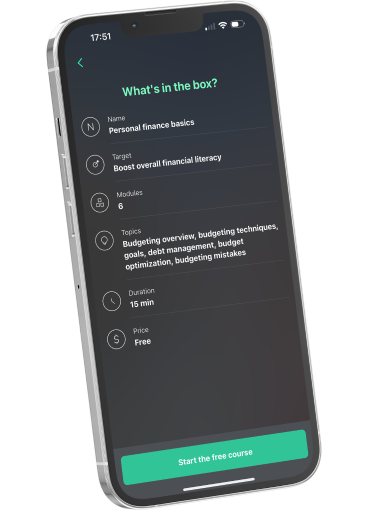
Become smarter about your money. Cover all the essential topics to enhance your understanding of personal finance, including budgeting techniques, debt management, and savings strategies.
This course was built by the team behind PocketGuard, the budgeting app trusted by thousands of users since 2015, who've spent over a decade helping people budget, pay off debt, and take control of their spending. Since 2024, more than 11,000 people have completed our basic personal finance course. And these lessons reflect the same principles that power the tools inside the app itself.
Last updated: September 21, 202615 minutes' worth of reading to start putting your knowledge to use right away in real life, optimize your budget, and save more.
No pressure. We just want to ensure this knowledge to stick so you can actually put it to use and improve your life. We've tried to keep it fun along the way.
Engage with the app by completing small budgeting tasks to strengthen your knowledge and onboard.
Know how to optimize your budget. Learn which budgeting mistakes to avoid and how to fix them.
Learn more about techniques such as compare & adjust, 50/30/20, envelope and zero-based budgeting.
Learn how to set and achieve goals, what SMART is, and how to refinance or put together a debt payoff plan.
This personal finance management course will help you to spend smarter, save more, make better decisions, and find your way to effective budgeting.
Hi,
Welcome to the PocketGuard personal finance basic course.
This short course will help you to become smarter about your money, make better decisions, and find your way to effective budgeting.
Every course part is a bite-size piece of useful information that makes you more informed about necessary aspects of money management.
A budget is an estimation of income and expenses over a specified future period of time and is usually compiled and re-evaluated on a periodic basis.
Budgeting is crucial to manage your monthly expenses, prepare for emergencies, and be able to afford some things you need without going into debt.
Keeping track of how much you earn and spend doesn't require you to be good at math, and doesn't mean you can't buy the things you want. It just means that you'll know where your money goes, you'll have greater control over your finances.
Creating and using a budget is not just for those who need to closely monitor their cash flows from month to month because "money is tight." Almost everyone—even people with large paychecks and plenty of money in the bank—can benefit from budgeting.
Budgeting is a wonderful tool for managing your finances, but many people think it's not for them. As was mentioned before, budgeting is a great way to find out where your money goes. Knowing not only your income but expenses as well makes you much better at decision-making. You'll be able to find plenty of room for improvement.
As you see, everyone needs a budget!
In general, traditional budgeting starts with tracking expenses and building an emergency fund. The emergency fund acts as a buffer and should replace the use of credit cards for emergency situations to eliminate debt growth.
The key is to build the fund at regular intervals, consistently devoting a certain percentage of each paycheck toward it, and if possible, putting in whatever you can spare on top. This will get you to think about your spending, too.
The more space you can create between your expenses and your income, the more income you will have to pay down debt and invest.
In a few words, good budgeting is to earn more than you spend and using that amount to put you in a better position by eliminating debts and growing savings.
The point of the budget is to help you build the financial future you deserve. So think about where you wanna be and keep in mind that sticking to your budget will help you get there.
Make it really difficult for yourself to make impulse purchases: set up barriers so you have time to stop and think: "Do I really need this stuff?" Remember, adding to your debt load will not put you in a good position.
It's difficult to predict how much money you'll need in every category of life. That's why it's important to have a regular check on how you've budgeted. If the current approach isn't working, tweak it. Use historical data to understand your spending habit and work on improvement.
Once again, make sure you keep your long-term financial goals in the picture.
Answer 1: To use a credit card wisely
This is a good thing to do but not the most important thing about budgeting.
Answer 2: To save money
That's important but savings is not the most important thing about budgeting.
Answer 3: To track expenses and make informed decisions
You are right! Knowing where your money goes is the most important thing about budgeting.
Answer 1: Those people who need to closely monitor their cash flows
These people definitely need a budget. But what about other people who will benefit from knowing where their money goes?
Answer 2: Only people with large paychecks
Really? What about people who try to make ends meet? Think again.
Answer 3: Everyone needs a budget
Yes. Everyone who cares about the financial future needs a budget.
Answer 1: To improve financial security
Yes. Having this buffer allows you to cover unexpected expenses without going deeply into debt.
Answer 2: I don’t need an emergency fund
Hm... What you gonna do if you lose a job or have to do major home repairs? C'mon!
Answer 3: Just in case
That's fair... partially. Lots of stuff can be that "just in case". An emergency fund is for emergencies. New PlayStation is not an emergency.
Figure out your after-tax income. If you get a regular paycheck, the amount you receive is probably it, but if you have automatic deductions for a 401(k), savings, and health and life insurance, add those back in to give yourself a true picture of your savings and expenditures.
However, if you work as a freelancer, have side hustles, earn hourly pay or overtime or rely on tips or commission, your monthly income is a bit harder to calculate. Take your income information for the past six months and calculate the average. This will be your starting point. You can adjust it anytime later.
The 50/30/20 rule is a simplified plan where you break down your expenses into three categories: needs, wants, and savings.
50% of your income should go towards needs, 30% should be devoted to wants, and 20% should get put into savings and emergency fund.
Dividing needs from wants can be tricky. "Needs" include your only vital necessities. You might think that groceries are a need, but there are items that are "wants." For example, the fruits and vegetables you buy at the store are a need, while the choco candies are a "want." Be honest to yourself. Needs and wants shouldn't be mixed.
The envelope budgeting method involves allocating a set amount of cash to each budget category for the month. This is hard but it works. To estimate the needed amounts you need some historical data to check how much money you've previously spent for each category.
The envelope method works especially well for people who find themselves overspending — they swipe first and do the math later. Instead, actually seeing how much money is left in the relevant envelope can be a great barrier to spending more than you'd planned.
You can track as many spending categories as you want but try to keep the process clear. Too much is not good.
Create a category budgetZero-based budgeting is a method that requires you to give every dollar a job. The goal is that your income minus your expenses equals zero by the end of the month. This method is extremely effective but really hard to manage.
You can use the same expense categories and amounts every month. It looks the same as envelope budgeting, which involves distributing money for different expense categories into envelopes, but nudges you to allocate the entire income.
The zero-based budget keeps you aware of how much money flows in and out. This can prevent you from spending what you don’t have.
Following a zero-based budget eats up lots of time. If you are new to budgeting, we suggest starting with simpler techniques like 50/30/20.
Compare your expenses to your income. If your spending is lower than or equal to your income, your budget is balanced.
In the opposite case, you need to adjust your spending. You can do this by playing with any of the non-fixed expenses.
An important thing about your adjustments is that you should focus on variable spending (such as your grocery or entertainment) before you reduce your savings for your financial goals. Protecting this line in the budget will help ensure you reach the important financial milestones that matter to you.
Answer 1: 50% for savings; 30% for bills; 20% for fun
Basically, the savings rate is a bit lower. Try again.
Answer 2: 50% for needs; 30% for wants; 20% for savings
You're right. Distribution money this way allows to cover all the basic needs and take care of savings.
Answer 3: 50% for needs; 30% for savings; 20% for wants
Hm... Almost. Try again.
Answer 1: All paychecks need to be cashed out and placed in an envelope to avoid overspending
This might work but you definitely should allocate some money for living.
Answer 2: The envelope budgeting method involves allocating a set amount of cash to each budget category for the month
You are right. The envelope method nudges you to know your spending categories, set limits, and stick to them.
Answer 3: The envelope budgeting method involves allocating a set amount of cash to at least 10 budget categories for the month
This method doesn't have recommendations about the number of categories you must set. It's up to you.
Answer 1: Zero-based budget forces you to give every dollar a job
You're right. This is how you can be aware of how much money flows in and out.
Answer 2: The easiest budgeting method in the world
Depends on the world. Try again.
Answer 3: The budgeting method I should start from if I'm totally new to budgeting
Zero-based budgeting is a bit complex for nubies.50/30/20 is a much better way to start budgeting.
Financial goals are savings, investment, or spending targets you work to achieve over some period of time. The current stage of life usually determines what type of goals you have.
The most common financial goal is to save enough money to purchase something. Let's say you saw those cool fancy shoes for $700. Can you buy them without affecting your budget? If not, it seems you have a financial goal. If you save $100 / mo (goal monthly contribution) you'll be able to buy those shoes in 7 months.
This is just a basic example of what the financial goal typically is and how it should be set to achieve in a reasonable period of time.
The best way to reach your financial goals is by making a plan that prioritizes your goals.
When you examine your own goals, you’ll discover that some are broad and far-reaching, while others are narrow in scope. Your goals can be separated into three categories of time:
The goal-setting process involves deciding what goals you intend to reach; estimating the amount of money needed and other resources required and planning how long you expect to take to reach each of your goals.
To make sure your goals are clear and reachable, each one should be:
SMART is an effective tool that provides the clarity, focus, and motivation you need to achieve your goals. It can also improve your ability to reach them by encouraging you to define your objectives and set a completion date. SMART goals are also easy to use by anyone, anywhere, without the need for specialist tools or training.
Answer 1: Financial goals are savings, investment, or spending targets you work to achieve over some period of time
You're right. The financial goal requires a clear target and deadline.
Answer 2: Financial goals are savings, investment, or spending targets you work to achieve someday
The financial goal requires a clear target and deadline. "Someday" is not an option.
Answer 1: People in government
Hah. Some of these guys definitely need to learn more about SMART goals. But try again.
Answer 2: Everyone
Sure thing. If the goal is specific, can be achieved in a reasonable timeframe, relevant to your needs and can be measured along the way, it gives tons of motivation to move forward.
Answer 1: Work hard or die trying
Good choice for those who know nothing about planning. Try again.
Answer 2: Design a plan and stick to it
Right. A plan gives you a direction, discipline gives you the power to implement it.
Answer 3: Do whatever you want. Success comes to people who deserve it
Hm... Take a look around. See all those desperate people? They have the same mindset. Try again.
The first thing you should understand is that debt has a ripple effect across your entire financial life, including your credit scores.
Revolving debt primarily comes from credit cards where you can carry, or revolve, a balance from month to month. You can borrow as much money as you’d like — up to a predetermined credit limit — and interest rates are subject to change. Your monthly payment may vary on revolving debt depending upon how much you currently owe.
Installment debt comes from mortgages, car loans, student loans, and personal loans. In most cases, the amount of money you borrow, the interest rate, and the size of your monthly payments are fixed at the start.
Remember, you must make payments on time. When you miss a payment, your lender could report it to the credit bureaus — a mistake that can stay on your credit reports for seven years. You may also have to pay late fees, which won’t impact your credit scores, but can be burdensome nonetheless.
Aside from your payment history, the way each type of debt affects your credit is quite different. With installment debt, like student loans and mortgages, having a high balance doesn’t have a big impact on your credit.
But revolving debt is another matter. If you carry high balances compared to your credit limits on your credit cards from month to month, it will likely have a negative effect on your credit scores — especially if you’re doing it with multiple cards.
It’s important to understand the total amount of debt you owe. Having a clear understanding of the numbers will empower you to make a repayment plan that actually works.
Many people may be unsure what the total is across all of the accounts, so the first thing to start is to visualize what you owe across different accounts.
Link all your credit cards to get the entire picture of your debt landscape.
After you’ve determined the total amount you owe, it’s time to dig a little deeper and read the fine print. Are you aware of:
It’s important to know the details because they will ultimately help you determine the best repayment plan.
A minimum monthly payment is the smallest amount of money due each month to keep your credit card account in good standing. Most banks determine the minimum payment by calculating 1% to 4% of the total balance owed, plus any interest and fees accrued that billing cycle.
Once you understand the big picture, it’s time to create a debt payoff plan. There are two main debt repayment strategies.
Debt snowball. Pay off the smallest debt first, while maintaining minimum monthly payments on all other debts. As each debt is paid off, the money that was used for the previous debt is “snowballed” and used to pay the next smallest debt. This process is repeated until all debts are gone. Choose this strategy if you need additional motivation by seeing debts get paid off one by one. But this will not save as much money as the avalanche method.
Debt avalanche. Pay off the debt with the highest interest rate first, while paying minimum monthly payments on all other debts. After that, consumers focus on the debt with the second-highest interest rate and repeat the process until all debts are gone.
Set up debt payoff planIt’s important to celebrate your debt repayment victories to keep your motivation high. Let's say you paid off the first $1000. Great! Treat yourself!
Set milestones within your larger debt payoff plan. Once you achieve one make something for yourself. What about ice cream?
Plan a budget for such things to stay on track. Especially if you follow a zero-based budgeting strategy.
You’ll never get out of debt if you’re continually adding to your balances. Stop using your credit cards, but don't close the accounts because that will hurt your credit score.
Stop getting loans so you don't have the ability to create additional debt. New debt increases the payments you have to make, which creates additional strain on your monthly income. It’s tough to live without credit cards, but if you’re serious about getting out of debt - find a way to live on your income.
A high-interest rate makes it harder to pay off your debt because more of your monthly payment goes toward interest charges. Lowering your interest rate reduces the monthly interest you pay and allows you to pay off your debt faster.
A good credit score and positive payment history give you more leverage toward getting a lower interest rate. If your credit card issuer won’t budge, consider transferring your balance to a credit card with a lower interest rate. Taking advantage of a 0% balance transfer offer is even better.
For anyone who finds themselves on the wrong end of credit card debt, personal loans can be a lifesaver. If you have a credit score of 650 or higher, you may qualify for a personal loan of up to $35,000, depending on the lender and your other financial qualifications. A personal loan may also have a lower APR than your credit cards, but this is not guaranteed — you should compare the APRs and fees before borrowing.
This is how you can save money on interest.
Answer 1: To stop increasing debt amount
Right. You should work to decrease, not to increase your debt.
Answer 2: To stop using credit cards
This could help but this is not the most important thing about debt management.
Answer 3: To have a debt payoff plan
Having a plan is good but this is not the most important aspect of debt management.
Answer 1: A debt payoff plan is your roadmap to a debt-free future
Right. A debt payoff plan is a step-by-step guide to a debt-free future.
Answer 2: I don't think it's important
Okay. We recommend to re-read a debt management module. By the way, we think you gave a wrong answer. Try again.
Answer 3: Because the budget must include all the spending I have
Yes, but this is not the main purpose of the debt payoff plan.
Answer 1: Snowball (the lowest balance first)
Wrong. This strategy gives you additional motivation by small debts fast repayment, but can't save you much money.
Answer 2: Avalanche (the highest interest first)
Right. By repaying the most expensive debts first you saving lots of money.
If your budget shows your expenses outweigh your income, search for ways to cut back. One of the easiest ways to trim your expenses is to evaluate how much money you’re spending on the things you want but don’t necessarily need. For example, a Starbucks coffee costs about $5. Let's say you get it 2-3 times a week. See the room for improvement? Good!
Another way to cut your expenses is to see if you can lower the cost of services you use.
Lower your billsSome months you’ll have to budget for things like school supplies or car maintenance. Other months you’ll be saving for things like birthdays and holidays. Make sure you prepare for those expenses in the budget. Keep those things from sneaking up on you.
Be sure to adjust your budget each month as things change. This will protect you from stress. Have a plan to make things predictable.
Make sure you aren't the only person in the household keeping a budget. Make sure to get the entire family involved. This is crucial for sticking to a budget.
Talks about money are never easy. Unless you have enough to buy all the stuff around. If you have a family budget, all the family should know how much money do you have this month to spend on all the things planned. This is important because everyone in the family should keep these numbers in mind to avoid overspending.
Once again. Talks about money are not easy. Be patient explaining the family budget and why everyone should stick to it. This may cause some stress along the way. Especially if you didn't budget before. But you are the only person who can take care of business and you'll do it for sure.
Make sure you set aside money for entertainment and leisure. You were working hard to earn your money. You did an amazing job by sticking to a budget. You deserve to treat yourself from time to time. Such small things will keep you mentally healthy and happy.
Have a coffee in a place you like, hit a movie or a game. Do anything that makes you happy. Budgeting is not about stress. Budgeting is about being smart about money to make you feel comfortable all the time.
You were working hard to earn your money. You did an amazing job by sticking to a budget. You deserve to treat yourself from time to time. Such small things will keep you mentally healthy and happy.
Have a coffee in a place you like, hit a movie or a game. Do anything that makes you happy. Budgeting is not about stress. Budgeting is about being smart about money to make you feel comfortable all the time.
If you’re only budgeting for your monthly spending and not your savings, your budget may be doomed from start. Bad things happen when we’re busy making other plans. Every reasonable budget needs a line for emergency savings. Are you one of the 37% of Americans who don't have an extra $400 in the bank for life's unexpected "blips"? Start fixing it now.
To avoid this budgeting mistake, make building your emergency savings a priority. Experts recommend an emergency fund covering at least 3 months of expenses. Try setting small, achievable goals first, like 5% of your income. If you follow the 50/30/20 pattern you know that savings should take about 20% of your income. Build your emergency fund first, then move forward to another financial goal.
Create a goal for the emergency fundA bulletproof budget begins with knowing how much you actually spend for living each month. Yes, it’s boring to sit down with all your bills and recurring charges to get accurate numbers. Those numbers are your key to a budget that works and drives you to the financial future you deserve.
To avoid this budgeting mistake - know monthly expenses. Including how much money you take out of the ATM in cash. Make sure that your budget is real and accurately reflects all your monthly obligations.
Having a budget might sound as if there’s no room for entertainment, but cutting fun out of your budget could become a really big mistake. It’s okay to want to pay off debts as quickly as possible, but you also need some money to keep your mental wellness. So, having fun is a must.
Remember the 50/30/20 pattern? 30% is for "wants". You can lower this limit if you're focused on achieving some financial goals right now. But keep in mind that you need a budget for fun to avoid burnout. A burnout person doesn't need a budget at all.
So, you set down to make a budget. You follow the pattern, research your spending habits, set spending limits. Now your budget seems almost perfect. You're satisfied with the work you've done and ready to meet your financial goals. But, life is life. Do your best to stay realistic with your expectations.
We told it a few times before but one again: review your budget every month to make it fit the current situation. The best budget is one that drives a balance between your financial goals and daily life. Don't be too strict with yourself. Anyone can fail. Adjust your budget when it's needed and move forward.
You've successfully completed PocketGuard budgeting quick course. It's time to apply the received knowledge to practice.
Remember, the budget itself is just a part of the success story. It takes really hard efforts to start following it. Almost everyone fails at the very beginning so don't blame yourself. Get lessons learned and move forward.
Hope you'll find PocketGuard as a reliable budgeting partner.
Sincerely yours,
Team PocketGuard

Improve your life using smart budgeting tools
PocketGuard is an all-in-one platform that brings together everything you need to optimize your finances. Join thousands of families using PocketGuard to achieve financial peace and security.
Start your free trialCancel anytime