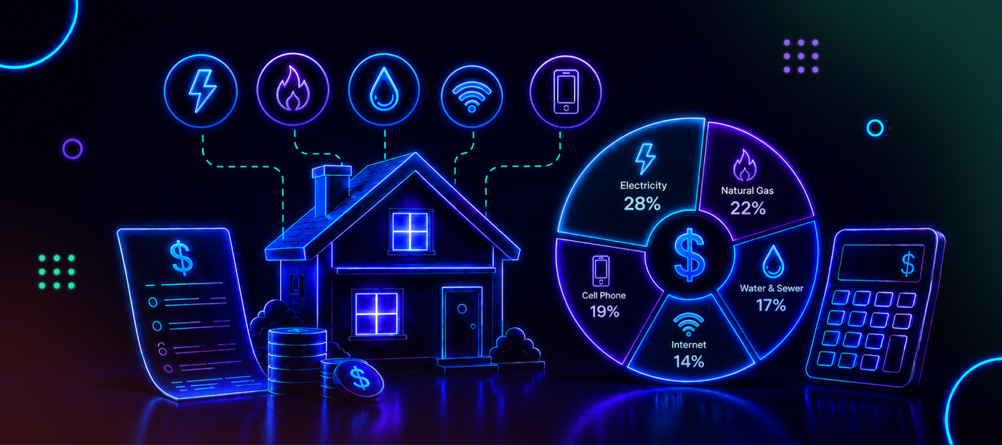
Somewhere around $565 to $610. That’s the average cost of utilities per month for a typical U.S. household in 2026, once you add up electricity, gas, water, internet, and a phone plan. Your own number could sit way outside that range depending on your zip code and how big your place is, but it’s a decent gut check for whether your bills are normal or getting out of hand.
And they probably are climbing, by the way. Electricity’s up about 47% since 2020. Gas has more than doubled in that same window, according to industry cost tracking. So no, you’re not imagining that your bills feel worse than they used to.

Take control of your money, optimize your spending and grow your savings automatically


Table of Contents
Quick Answer: Average Monthly Utility Costs
Here’s the full lineup, based on 2026 national averages.
| Utility | Average monthly cost |
| Electricity | $190 |
| Natural Gas | $150 |
| Water & Sewer | $100 |
| Internet | $95 |
| Cell Phone (household) | $125 |
| Total (all five) | ~$660 |
That lines up pretty closely with the $610 figure Move.org’s 2026 report came up with, give or take, depending on where you live and what actually gets counted.
What Counts as a “Utility,” Exactly?
There’s no official list, honestly, which is part of why estimates online are all over the place. Electricity, gas, and water and sewer are the three nobody argues about, since they keep a house running. Trash and recycling often get lumped in too, especially in cities where it’s a separate line item instead of buried in property taxes.
The Internet and phone are murkier. Some people count them as core utilities. Others file them under “stuff I choose to pay for,” since technically you could live without either. This breakdown counts both, mostly because almost nobody actually goes without them in 2026.
Breakdown by Category
Electricity: ~ $190/month
This is usually the biggest number on the list. The EIA puts the national average around $160 a month based on roughly 850 kWh of use, though houses tend to run higher than apartments thanks to central AC and more square footage to cool. Rates jumped about 10% year over year heading into 2026, so if your bill feels off compared to last year, it probably is. Worth checking this guide on how to save on electric bill costs before just accepting a higher number as the new normal.
Natural Gas: ~ $150/month
Gas swings hard by season, and this range mostly reflects winter, when heating is actually running. Mild climates or all-electric homes pay a lot less, sometimes close to nothing in July. The real story is the five-year trend though: gas prices have more than doubled, one of the sharpest jumps of any category here.
Water & Sewer: ~ $100/month
Water tends to be the steadiest bill of the bunch, since it doesn’t get whipped around by fuel prices the way electricity and gas do. Still climbed, though. Rates are up close to 59% over five years in a lot of cities, mostly because aging pipes finally need replacing and someone has to pay for it. This guide on the average water bill per month breaks it down further by household size.
Internet: ~ $95/month
Depends almost entirely on speed tier and how much competition exists where you live. One provider in a rural area can charge more for worse service simply because there’s no alternative, while cities with three or four options competing tend to land near the low end. This average internet bill guide walks through what different speed tiers actually cost.
Cell Phone: ~ $125/month (household)
This is a whole household, not one person on one line. Family plans knock the per-line price down, but once device payments, data add-ons, and taxes get added in, the total still tends to land in this range. This average cell phone bill breakdown covers what actually drives it up or down.
What Affects Your Utility Bill
Location does more here than almost anything else. The average cost of utilities for a house per month in West Virginia runs around $734. In New Mexico, it’s closer to $395. That’s nearly $4,000 a year of difference between two otherwise similar homes, just based on state. Climate matters too, since heating and cooling make up about half of a typical electric bill, so a brutal summer or a long cold winter hits everyone harder no matter how careful you are.
Home size and household size both push the number too, though not always in obvious ways. A bigger house obviously takes more energy to heat and cool, sure, but it’s really the number of people under one roof that drives water and electricity up fastest – more showers, more loads of laundry, more phones and laptops sitting on chargers all night that nobody thinks twice about. And an old house with drafty windows and a water heater from the Clinton administration will just cost more to run than a newer place, even if the square footage on paper looks identical.
How to Lower Your Total Utility Costs
“Small changes add up” is one of those lines that sounds like filler until you actually try it. Turning the thermostat down two degrees doesn’t feel like it should matter. Finally sealing that draft by the back door you’ve walked past for a year doesn’t feel like much either. But stack a handful of these over twelve months and the total actually moves, more than most people expect from stuff this boring.
Shopping around is the other lever, and it’s the one people skip most. In deregulated electricity markets, switching providers can lower your bills without changing a single habit. Bundling the internet and phone sometimes helps too, though check the actual math before assuming a bundle is cheaper, because sometimes it isn’t. And on the water side, that running toilet you’ve been meaning to fix for three months, or showers that run five minutes longer than they need to, quietly cost more over a year than most people would guess.
Track Utility Spending Automatically
Nobody actually remembers what last month’s electric bill was. Ask most people and you’ll get a shrug, maybe a guess. That’s kind of the problem. If utilities live in that vague “I’ll deal with it when it’s due” mental folder instead of getting tracked as a recurring expense, a rate hike or a usage spike can sit there for months before anyone notices.
This is where an app earns its keep, honestly. Something that pulls spending insights automatically will just flag it when a bill jumps compared to prior months, no spreadsheet required. Could be a rate increase. Could be a leak somewhere you haven’t found yet. Could be that space heater someone’s been running in the garage all winter. Either way, you find out in month two instead of month six.
The Bottom Line
$565 to $610 a month, give or take. That’s the honest range for the average cost of utilities per month right now, and yes, “give or take” is doing a lot of work in that sentence since your address and your square footage can move the number by hundreds of dollars either direction. Electricity and gas are where most of the unpredictability lives. Water barely budges by comparison.
The real takeaway isn’t the number itself, though. It’s that most people never look at these bills individually, they just see one lump sum draining the account and shrug. Break it apart by category and suddenly it’s obvious where the actual problem is, and whether it’s even worth fixing.
FAQ
What’s the average cost of utilities per month for just one person?
Less across the board, especially water and electricity, since usage scales with how many people are actually in the house. Someone living alone often lands closer to $250 to $350 total, well under the full-household number.
Is the average cost of utilities for a house per month higher than an apartment?
Usually, sometimes by double or more. More square footage, separate heating and cooling zones, that kind of thing. Apartments also often bundle water or trash straight into rent, which quietly lowers whatever separate utility bill shows up.
Why did my bill jump out of nowhere?
Rate hikes, most of the time, especially for electricity and gas, both of which have climbed hard the past few years. Could also be a seasonal shift, a new appliance, or something like a leak that hasn’t been caught yet.
Do streaming services count as utilities?
Not really, though plenty of people budget for them like they do. Most breakdowns keep streaming and cable separate from the core utilities, electricity, gas, and water.
How do I figure out my own utility costs before moving somewhere new?
Call the local providers directly and ask for average rates in that specific area. National averages can be off by hundreds of dollars once you get down to a specific state or even city. A lot of providers also post average bill estimates by home size right on their websites.

Take control of your money, optimize your spending and grow your savings automatically