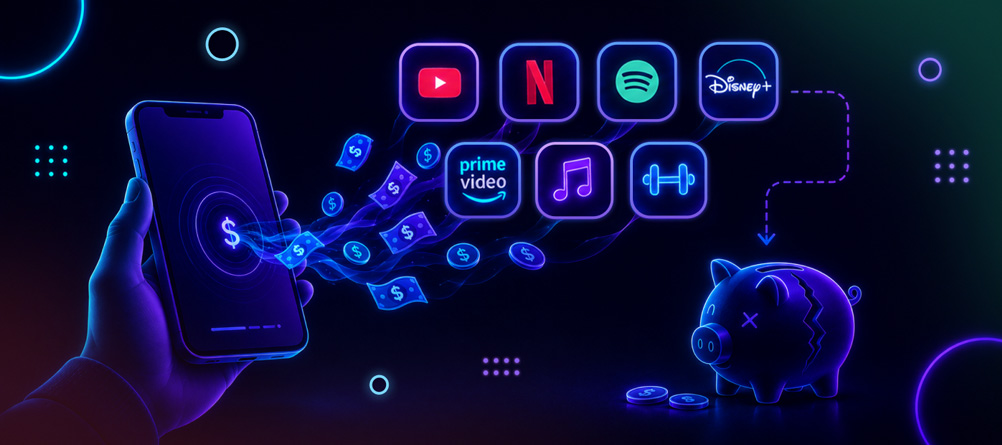
Subscription creep is the slow, mostly unnoticed buildup of recurring charges that adds up to real money before anyone sits down and adds it up. It’s not one bad decision. It’s a dozen small, reasonable-sounding ones that never got revisited.
Key takeaways:

Take control of your money, optimize your spending and grow your savings automatically


- Subscription creep happens through small individual charges, not one big purchase, which is why it’s so easy to miss
- Free trials, sunk cost thinking, and quiet price increases are the three psychological traps doing most of the damage
- Most people underestimate their own subscription spending by more than double
- Tracking works because it replaces memory and guesswork with an actual number you can see
- A few minutes reviewing recurring charges each month tends to save more than most people expect
Table of Contents
Why Subscription Creep Feels Invisible Until It Isn’t
Ask someone what they spend on subscriptions and you’ll usually get a number that’s low, sometimes by a lot. According to C+R Research, the average American estimates around $86 a month, while actual itemized spending comes out closer to $219 once every category gets counted. That gap compounds to roughly $1,596 a year per person. It’s not that people are bad at math. It’s that nobody’s actually adding these charges up in the first place.
Part of the reason is structural. Around 74% of people say recurring charges are simply easy to forget, and 42% admit they’ve kept paying for something they don’t even use anymore. Add auto-pay into the mix, and you’ve got a system that was practically built to be forgotten. West Monroe’s research found that 72% of consumers have every subscription set to auto-pay, and 42% have forgotten about at least one entirely while still being charged for it. The charge clears, the bank balance drops a little, and nothing about that moment tells you why.
If you’re wondering what subscription creep is in plain terms, that gap is really the whole answer. The subscription creep meaning isn’t about any one charge, it’s about the distance between what you’re paying and what you think you’re paying, and how comfortably that distance sits unnoticed for years. West Monroe’s broader survey put the average household subscription bill at $273 a month, spread across streaming, software, fitness, food delivery, and a handful of things most people forget they ever signed up for.
The Psychological Traps Behind It
None of this happens because people are careless. It happens because a few very specific mental shortcuts make each individual subscription feel harmless, even when the total isn’t.
Sunk cost, free trial anchoring, and price creep normalization
Sunk cost is the easiest one to recognize once someone points it out. You’ve paid for six months of a fitness app you stopped opening in month two, and canceling now feels like admitting the first six months were wasted. So you keep paying, which is a strange kind of logic when you think about it, since the money’s already gone either way.
Free trial anchoring works a little differently. The trial sets an anchor of “free,” and once the card gets charged, the new price feels smaller than it actually is, simply because it’s being compared to zero instead of to your actual budget. Introductory dollar trials alone boost conversion by around 38%, which tells you how well this particular trap works on its own.
Then there’s price creep normalization, probably the quietest of the three. A service goes from $9.99 to $12.99 with an email nobody reads closely, and the increase gets absorbed without much thought, because two or three extra dollars doesn’t feel worth the hassle of canceling. Do that across eight or ten subscriptions over a couple of years and the total creeps up steadily without a single moment that felt like a decision. This gradual increase is similar to lifestyle inflation, where spending grows so slowly that it rarely feels like a conscious choice.
Layer these together and it’s easy to see why the numbers get away from people. West Monroe found that 89% of consumers underestimated their own monthly subscription spending, with 66% off by more than $200 and 13% off by more than $400. None of that is really a math error. It’s what happens when every individual subscription decision gets made in isolation, without the full picture in front of you.
How Tracking Interrupts the Pattern
Every trap above depends on one thing: the total staying out of sight. Tracking fixes that by putting the number in front of you, whether you were ready to see it or not.
The mechanism is simple. Once every recurring charge is listed in one place instead of scattered across bank statements and app store receipts, sunk cost gets a lot less powerful, because you’re comparing the ongoing cost to your actual budget rather than to what you already paid. Free trial anchoring loses its grip once the trial shows up on a calendar with an end date attached to it. And price increases stop sliding by unnoticed once there’s a running total that visibly ticks upward the month a price actually changes.
This is really the whole case for using a recurring bill tracker instead of trying to keep a mental list. Memory is exactly the thing subscription creep exploits, so replacing memory with a visible record is the most direct fix available. A subscription cancellation app takes it one step further by making the exit as low-friction as the sign-up was, which matters more than it sounds like it should, since plenty of services are built to make canceling annoying on purpose. Together, they’re about as close as it gets to tools to avoid subscription creep without babysitting your bank statement every week.
| Approach | What it catches | What it misses |
| Checking bank statements manually | Charges you happen to notice while scrolling | Charges buried among dozens of other transactions |
| Reviewing app store purchases | Mobile app subscriptions | Charges billed through a browser or third party |
| Using a dedicated tracker | All recurring charges in one running total | Nothing, if every account is linked |
| Doing nothing | Nothing | Everything |
What It’s Actually Costing You
The dollar figures are worth sitting with for a second, because they’re bigger than most people assume going in.
Bango’s 2025 survey found that Americans now pay for an average of four AI subscriptions at roughly $66 a month, with 14% paying for eight or more. That’s an entirely new category of recurring charges that barely existed a few years ago, stacked right on top of everything else already running in the background.
Streaming isn’t innocent either. Deloitte’s 2025 survey put the average household at 4.5 streaming platforms for a combined $69 a month, up 13% year over year, and that figure doesn’t even touch music, gaming, or fitness apps. Once those get added in, the household total from West Monroe’s research climbs to $273 a month, which works out to well over $3,000 a year for the average family.
Most of that total isn’t one big expense. It’s the kind of thing that belongs on a list of fixed expenses right alongside rent and car payments, even though it rarely gets treated that way, because no single line item feels significant enough on its own to earn a spot on the list. Reviewing what counts as typical monthly expenses is a useful gut check here, since subscriptions have quietly become one of the largest recurring categories most households carry without really deciding to.
Final Word: Awareness Is the Real Unsubscribe Button
Every trick that keeps subscription creep alive runs on the same fuel: not looking closely. Sunk cost, trial anchoring, price creep, all of it depends on the total staying vague enough that no single charge feels worth questioning.
That’s really the answer to anyone trying to stop subscription creep for good, and it’s less about willpower than people expect. It’s about seeing the number clearly enough that the decision makes itself. Tools built for this, like PocketGuard’s spending insights, pull every recurring charge into one place so the pattern is obvious instead of buried across a dozen statements. Pair that with an occasional pass at negotiating your bills, since a handful of services will lower their price the moment you ask, and the total starts moving in the right direction without much drama attached to it.
None of this requires canceling everything and living without streaming or software. It just requires knowing what you’re actually paying for, on purpose, instead of finding out by accident a year later – and being honest about which of those charges are needs vs. wants in the first place.
Then there’s price creep normalization, probably the quietest of the three. A service goes from $9.99 to $12.99 with an email nobody reads closely, and the increase gets absorbed without much thought, because two or three extra dollars doesn’t feel worth the hassle of canceling. Do that across eight or ten subscriptions over a couple of years and the total creeps up steadily without a single moment that felt like a decision. This gradual increase is similar to lifestyle inflation, where spending grows so slowly that it rarely feels like a conscious choice.

Take control of your money, optimize your spending and grow your savings automatically